Perception of Exponents
March, 2026
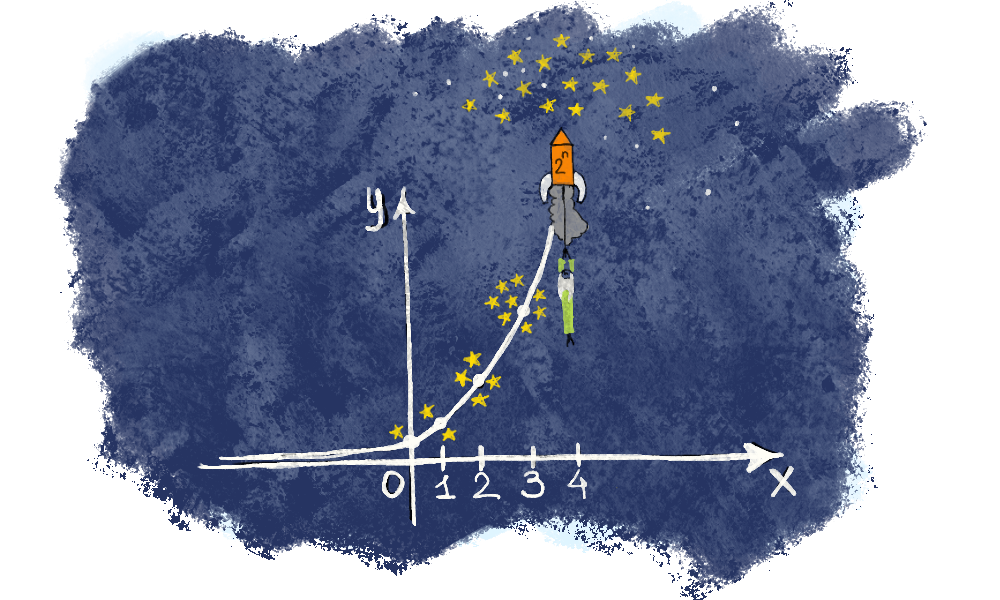
Exponents are very counterintuitive, they get very big very fast. I find it helpful to always keep this number in mind: the number of atoms in the observable universe is about 2300, actually about 2266 more precisely. So with 256 bits one can count 1/1000-th of the atoms in the Universe. Therefore a brute-force search for a 256-bits key would have to “look under” each 1000-th atom in the universe… that “actually feels” like a safe margin!
I also find it very helpful to know how much hashing the Bitcoin network is currently doing per second, that’s about 270 (and thus 295 per year). Then it makes sense, why 80-bits keys are no longer considered adequate.
Here are some more helpful numbers along these lines:
- 225 seconds in a year;
- 234 hashes/second modern GPU (GeForce RTX 4090 - $2,000)
- 250 hashes/second industrial-grade miner (Bitmain Antminer S23 Hyd 3U - $30,000 + $5,000/year for electricity)
- 259 the age of the universe in seconds
- 270 hashes/second Bitcoin network
- 273 number of stars in the Universe
- 280 steps to attack considered feasible
- 295 hashes/year Bitcoin network
- 2128 steps to attack is about the lifetime of the universe for bitcoin hashpower if one step is one hash
- 2256 steps an attacker would not be able to do ever
- 2266 atoms in the observable universe
- 2403 the number of ops the universe has made in its lifetime, if one atom is one compute device doing one op at a speed the light traverses its diameter (1 fm) (see the paper of Lloyd from 2001 for a more accurate assessment).
It is only meaninful to think about an exponential-time algorithm, O(2n), for inputs of small length n < 300. For larger n it becomes kind of meaninless. Same is true for a polynomial-time algorithm, if the runtime is O(n300) it samewise infeasible.
I was once in a group of students helping Don Knuth to clean-up a small local library in the Stanford’s CS department. At the time he was working on SAT solvers for Volume 4 of his The Art of Computer Programming book series. When we were done, I asked him: “What’s your intuition now, do you think P = NP or not?” And his answer was most remarkable. He said he feels P = NP, but the degree of the polynomial would be so large, that it is not tractable in any practical sense. Indeed, if it takes O(n300) time to solve an NP-complete problem, it is well above feasible. So cryptographers would still stay in business ;)