Hashing in Merkle Trees
February 16, 2026
A hash function compresses the input into a fixed-length string. It can be used for compression itself, but might also be used to remove structure from a user’s input for security purposes (e.g. when signing a message).
A typical blockchain uses a hash function in the following common cases:
- constructing Merkle trees and Merkle proofs,
- hashing a transaction being signed,
- proof-of-work,
- hashing public keys to generate shorter addresses.
Here, we focus on the use of a hash function in Merkle trees.
Because hash functions compress data, collisions are inevitable, but they are hard to find. For current standards, not a single collision is known, and finding two points that collide - even by sheer luck - would likely render the hash function unsuitable for futher use.
Depending on the application, we require different security properties from a hash function:
- Preimage resistance: given h it is hard to find x such that H(x) = h.
- Second preimage resistance: given x, it is hard to find x’ ≠ x such that H(x) = H(x’).
- Collision resistance*: hard to find x1 ≠ x2 such that H(x1) = H(x2).
*Due to birthday paradox a hash function that outputs t bits is at most t/2-bits collision resistant.
Note that collision resistance is the strongest property of all. Collision resistance implies second preimage resistance implies preimage resistance (for sufficiently long inputs which we will consider here).
And, occasionally, additional property is required (especially when hashing secrets):
- Length-extension resistance: given H(x), it should be difficult to find a pair: ext and H(x || ext). In other words, it should be difficult to extend the input of the hash function while knowing only its output. This usually comes up as a problem when hashing secrets; in such cases, an HMAC (as defined in RFC2104 provides length-extension resistance for hash functions that would otherwise be vulnerable.
Although for completeness, it should be noted that some exotic properties are sometimes considered for keyed hash functions, e.g. target collision resistance (TCR), enhanced target collision resistance (eTCR), etc.
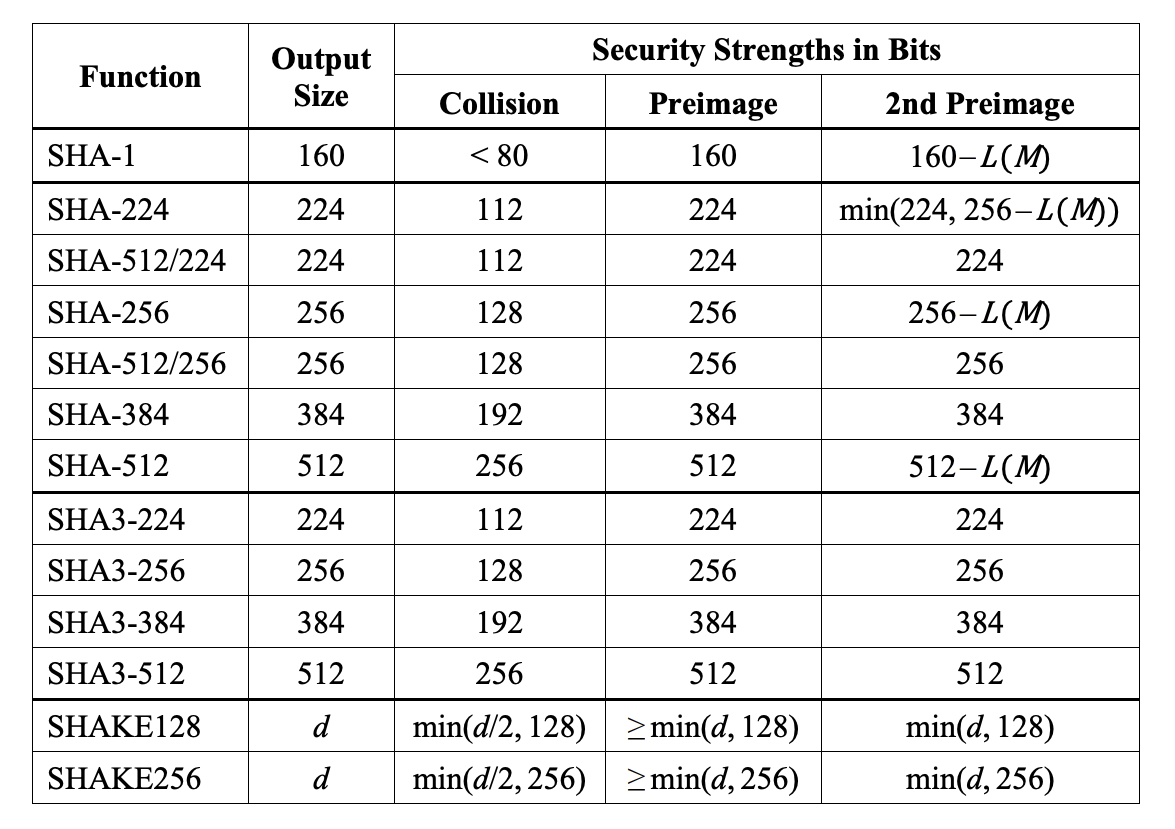
For Merkle trees, we require a hash-function with at least 128-bits of collision resistance. By the birthday bound, this implies that the internal hash-function should produce at least 256 bits of output.
History of NIST standards for hash functions: The Secure Hash Algorithm (SHA) was developed by NSA and published by NIST in 1993 as FIPS-180. This first version is now refered to as SHA-0. SHA-0 outputs 160-bit digests, hence was only 80-bits collision resistant at best. In 1995, NSA added an extra instruction to the SHA-0’s compression function, NIST updated the standard accordingly without giving any rationale behind the change. The resulting function was called SHA-1. Ten years later it was found that this extra instruction was crucial for collision resistance. SHA-1 became the de-facto standard for collision resistant hashing. As SHA-1 started seeing more and more attacks, in 2001 SHA-2 developed by NSA was added to the standard, now becoming FIPS 180-2, it is three to four times slower than SHA-1. In 2011 NIST recommended to move from SHA-1 to SHA-2 as attacks discovered in 2005 in SHA-1 were becoming more practical. In February 2017 a collision was found as two distinct pdf documents, so for crypto-applications SHA-1 is mostly abandoned, although it is still believed to be a one-way function (i.e. to satisfy the preimage resistance property). Unlike SHA-1 and SHA-2, which were designed by the NSA and then released as public-use patents, SHA-3 was selected through a public competition organized by NIST. The competition began in 2017, and the winning design was standardized in 2012 as FIPS-202.
Current NIST standards for hashing (see NIST-FIPS-202):
SHA-2
SHA-2 standardized in 2001 and specified in FIPS 180-4, is often informally refered to simply as “SHA”. It has modes that give 224, 256, 384 or 512-bits output.
SHA-2 follows the Merkle-Damgard paradigm with Davies-Meyer-type compression function. For a block-cipher E, the compression function iteratively processes fixed-size message blocks together with a chaining value:
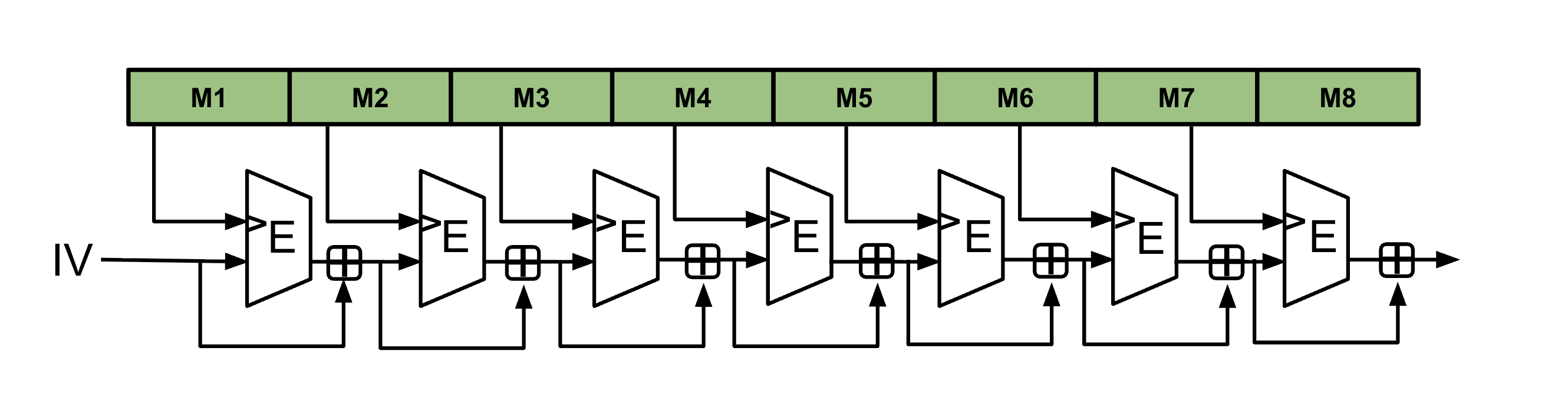
The underlying block cipher E used for SHA-2 is NIST-designed SHACAL-2 cipher running the round function on a 64B block for SHA2-256 (or on a 128B block for SHA2-512) with different pre-specified round keys: 64 rounds for SHA2-256 and 80 rounds for SHA2-512. Attack on SHA2-512/256 (2016) found collision for 43 rounds (out of 80). Attack on SHA2-256 (2011) found collision for 46 rounds (out of 64). No practical attack are known on full SHA2 other than the trivial birthday-bound.
Two modes give 256-bits output: SHA-256 and SHA-512/256, the former is more frequently used. SHA2-512/256 is SHA2-512 with a different IV vector truncated to 256 bits. It is sometimes used in place of SHA2-256 as it is faster on 64-bits architectures and also resistant against length-extension attacks.
SHA2 Native Instruction: SHA2-256 has a native instruction in many modern processors making it about 10x faster! Even SHA2-512 is harware-supported on modern ARM processors.
Note that AES can’t easily be used out-of-the-box for E, since AES has 128-size blocks thus giving only 64-bits security for collision resistance. AES is also too slow for short-messages due to key-switching overhead.
Block size and padding. SHA2-256 has 64B-size blocks. Padding for SHA2 is 10*L, where L is a 64 bits long length (in bits) of the original message, so SHA2-256 the padding always adds at least 65 bits to the message. When hashing a 64B-input, the conventional padding will overflow the input making it two blocks instead of one, which for example is a 2x overhead for internal Merkle binary tree nodes. SHA2-512 has 128B-size blocks. The padding for SHA2-512 is 10*L, where L is a 128 bits long length (in bits) of the original message. So this padding adds at least 129 bits to the message.
Bitcoin is using SHA2-256 for the proof-of-work challenges. All of Bitcoin miners are collectively computing 2^95 hashes per year. Bitcoin also constructs a Merkle tree for a block with transactions as leaves, using double SHA2-256, the root of the tree is put into a block’s header.
SHA-3
SHA-3 (FIPS 202) was standardized in 2015. While there is nothing wrong with SHA-2 (as of today), SHA-3 got standardised to diversify the crypto-toolkit as new attacks were being discovered for SHA-1 which shares similar designs with SHA-2. So, in the event one of the functions get broken, we have another one to substitute with (though it has its own controversies).
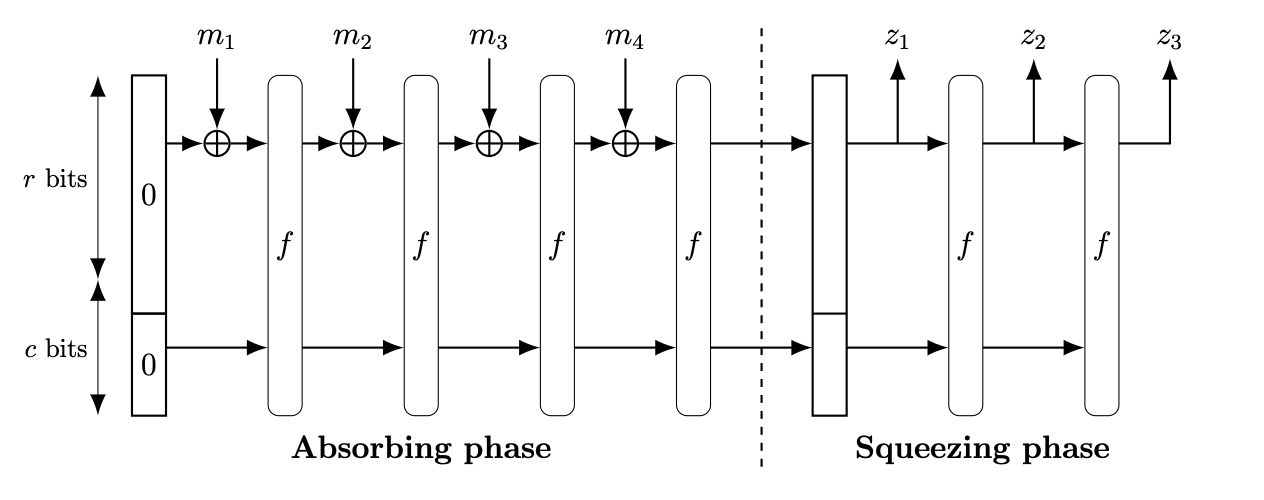
From “A Graduate Course in Applied Cryptography” version 0.6 by Dan Boneh and Victor Shoup
SHA-3 is a sponge construction. Where the function f is a public premutation called Keccak that maps 1600-bits to 1600-bits. For SHA3-256: c = 512 bits, for SHA3-512: c = 1024 bits. For SHAKE128: c = 256 bits, for SHAKE256: c = 512 bits. The output is r first bits of the last execution of f. The c last bits are not part of the output, giving length-extension resistance in contrast to SHA-2. f includes 24 rounds of iterations: an attack on SHA-3 (2019) found a collision on 5 rounds (out of 24); no attacks are known on full SHA3 other than the trivial birthday bound. SHA3 can be accelerated a bit with AVX vector instructions, and ARM-processors have accelerated hardware instructions for Keccak now.
Two modes give 256-bits output and have 128-bits of collision resistance: SHA3-256 and SHAKE128 (with 256-bits output).
Padding and block-size. Padding for SHA3 is 01 || 10*1, for SHAKE is 1111 || 10*1. SHA3 blocks are larger than SHA2 (for SHA3-256 blocks are 136B).
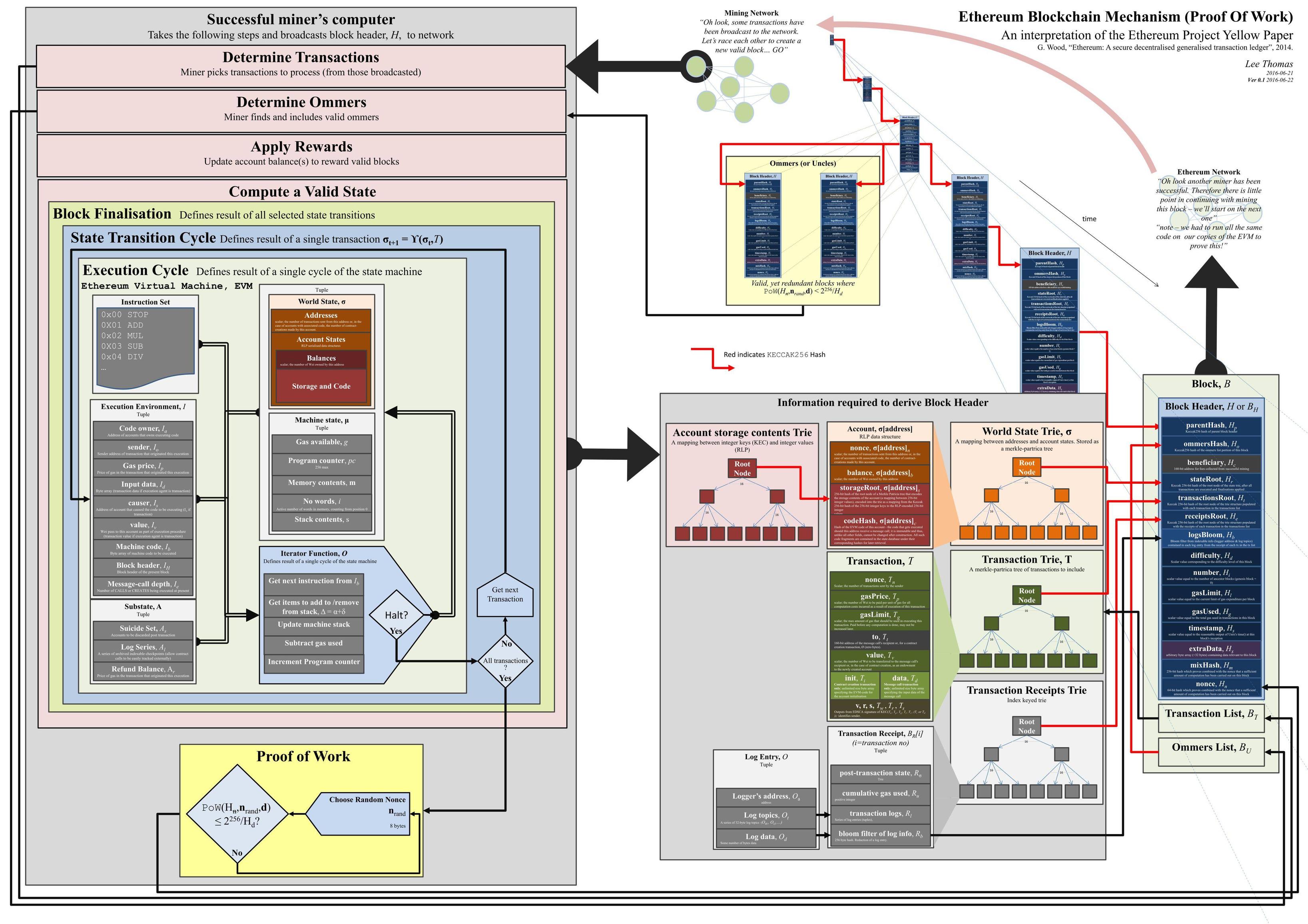
Ethereum is using Keccak-256 (which is not SHA3, though quite the same): Ethereum launched just before FIPS 202 was published (August 2015) but after the Keccak was announced as a winner, so Ethereum’s hash function has some minor differences from SHA3. It’s used in different Merkle trees, including for accounts’ states. It had been used for proof-of-work mechanism, which since retired in favor of proof-of-stake.
Hashing in Merkle Trees
Hashing in a tree-fasion is done to either parallelize hashing, or to make it easier to do small changes to the large data being hashed, or for Merkle-tree accumulators which serves as cryptographic commitments with efficiently computable proofs of inclusion.
Under some plausible assumptions, it was shown that to get (n*256)-to-256 collision-resistant function from 512-to-256 collision-resistant function, n-1 calls are required, so Merkle trees and Merkle-Damgard construction (e.g. SHA-2) are in some sense optimal.
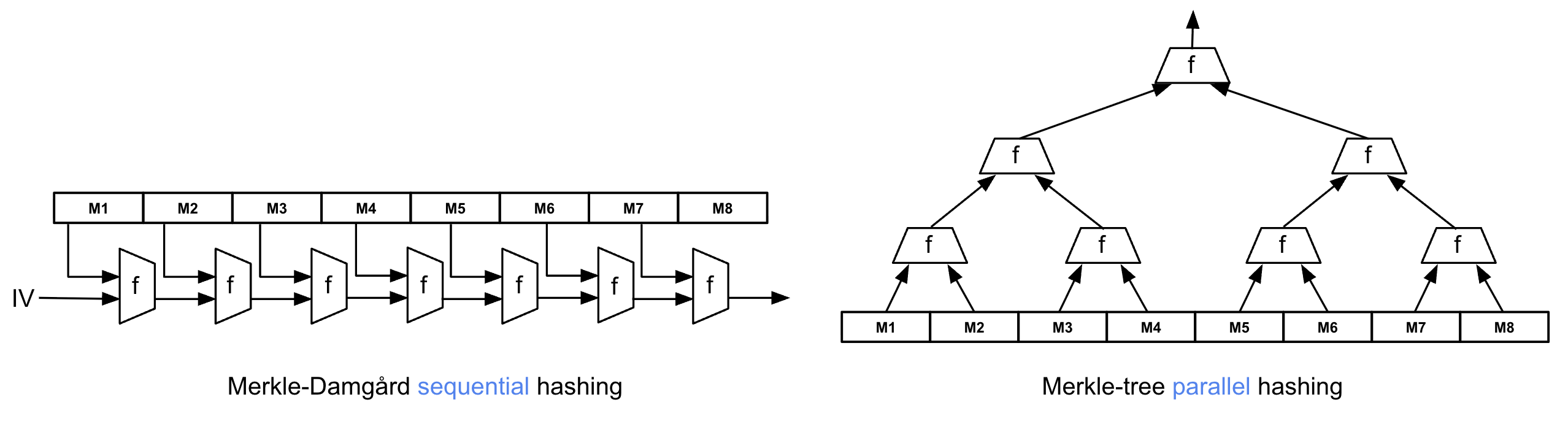
The trees in accumulators can get rather big, for example:
-
Certificate Trasparency Logs (RFC9162) are “append-only” and publicly-auditable ledgers of certificates being created, updated, and expired. There are a number of them run by Google, Cloudflare, Sectigo, DigiCert and others (see stats). Some of the longest for example have 93M, 77M, 76M entries. That gives binary trees of about 27 levels high.
-
Ethereum currently has around 363M addresses, but the account trees are not binary, they are 16-ary Merkle Patricia Tries - the place of the account in a trie is determined by the 256-bits hash of 160-bits account’s address, and tree branches are not instantiated all the way to the bottom of the trie, but kept compressed. Because of the large ary-ness of the tree, the Merkle proofs are large than for binary trees, but since the height of the tree is low, there are less nodes to update on leaf changes saving disk I/Os and CPU-time.
-
BitTorrent is using binary Merkle trees: the file by default is split into 16 KB blocks that are first hashed with SHA2-256 and put in a Merkle tree. For a 10GB file, the tree would be about 20 levels high.
Performance
Let’s measure performance of NIST hash functions with 256-bits outputs. I run benchmarks on Rust crates on Apply M3 Pro (2023), and for long inputs I’ve got:
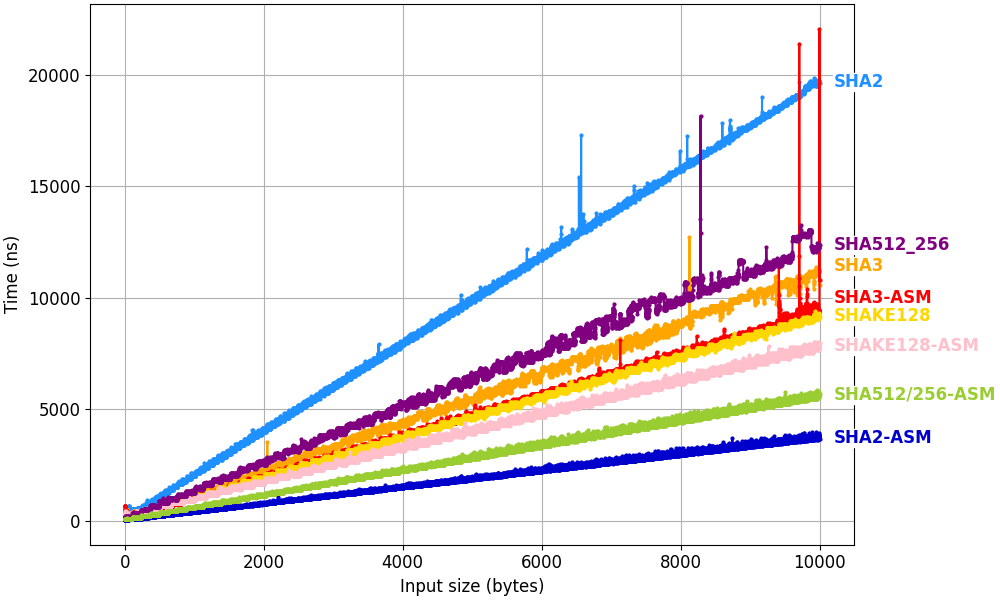
In the “-ASM” modes, the code is compiled for “native” cpu, and uses available hardware instructions, which means native instructions for SHA2 and SHA512/256, and AVX acceleration. With no “-ASM” modes, the code is compiled for “generic” cpu, default features are disabled (except 'force-soft' on SHA2 to enforce software implementation). Rust version 1.91.1, and crate versions: SHA2 0.10.9, SHA3 0.10.8.
This is obviously just a playground-type benchmark. There are more robust and detailed benchmarks available, most notably SUPERCOP.
Let’s take a closer look at the left side of the graph above and see how those function perform on small inputs. The graphs jump in steps with the block-length as expected:
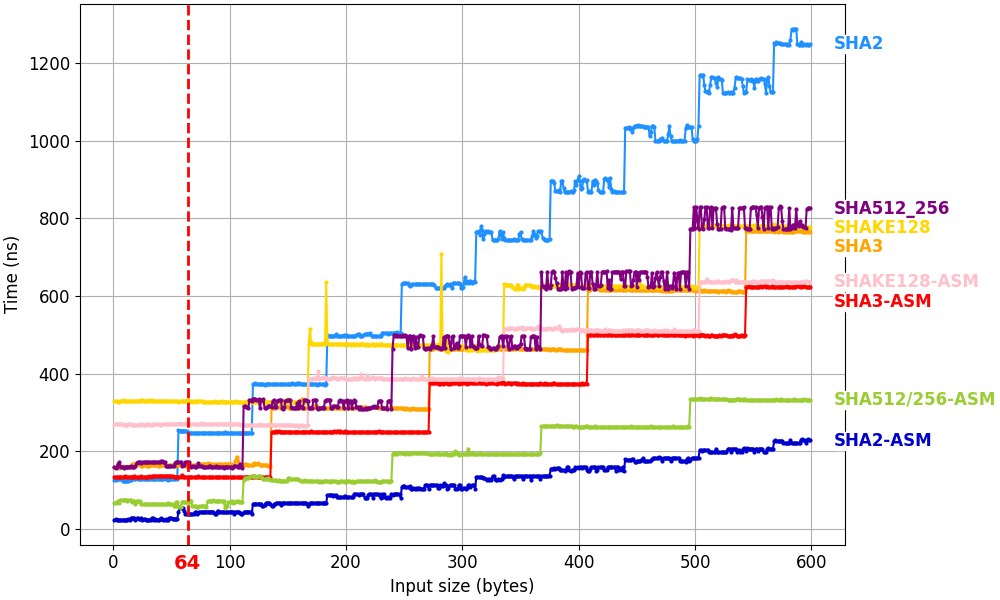
Finally, for performance in binary Merkle trees, let’s look at a specific point of these graphs for hashing 64 bytes input. In this case, the function is 2-to-1 compressing, it takes 512-bits input and gives 256-bits output. The difference in performance is quite remarkable. Some of the functions that tend to be very fast on long inputs perform poorly on inputs that are these small:
| 328 ns | SHAKE128 |
| 270 ns | SHAKE128-ASM |
| 248 ns | SHA2 |
| 165 ns | SHA3 |
| 162 ns | SHA512-256 |
| 134 ns | SHA3-ASM |
| 128 ns | SHA2 no padding |
| 70 ns | SHA512-256-ASM |
| 45 ns | SHA2-ASM |
| 25 ns | SHA2-ASM no padding |
Droping the padding/domain-separation would require careful in-protocol handling (to maintain collision-resistance of the tree construction) at the benefit of better performance.
Some highly-secure applications might want to have a security boundary between storage and execution; and check merkle proofs on every read from the database (for example, an HSM using external memory). Performance of the hash-function will then become even more important.
Other notable hash functions
-
BLAKE - designed in 2008 was one of five NIST finalists for SHA-3, designed by J.P.Aumasson, L.Henzen, W.Meier, R.C.W.Phan. It relies on a core permutation built from ChaCha stream cipher. The initial BLAKE submission (2008) had 14 and 10 rounds for two variants, the later increase to 16 and 14 (2010) was apparently motivated by already high speed of BLAKE.
-
BLAKE2 (RFC7693) - designed in 2013 by J.P.Aumasson, S.Neves, Zooko Wilcox-O’Hearn, C.Winnerlein - is in an improved-performance version of BLAKE with a reduced number of rounds (12 and 10), the team says: “based on the security analysis performed so far, and on reasonable assumptions on future progress, it is unlikely that 16 and 14 rounds are meaningfully more secure than 12 and 10 rounds.” BLAKE2 is designed to be efficient on a single CPU core (BLAKE2b with 12 rounds is more efficient on 64-bit CPUs, produces digests of any size between 1 and 64 bytes; and BLAKE2s with 10 rounds is more efficient on 32-bit CPUs, produces digests of any size between 1 and 32 bytes). BLAKE2bp and BLAKE2sp are designed to be efficient on multicore or SIMD chips. BLAKE2 is faster than SHA-3 and SHA-2.
-
BLAKE3 - designed in 2019 by J.O’Connor, J.P.Aumasson, S.Neves, Zooko Wilcox-O’Hearn is an attempt to unify all the different variants of BLAKE2 into a single hash-function that performs well on all architectures. It has even smaller number of rounds (7 instead of 10 in BLAKE2s). BLAKE3 splits its input into 1024 bytes chunks and arranges them as the leaves of a binary tree, each chunk is compressed in parallel. Has 128-bit security level and 256-bit default output size.
-
ParallelHash - published by NIST in 2016 as designed for hashing long messages by taking advantage of the parallelism in the processors. First the input is split into blocks, each block is hashed in parallel, then a single pass of cSHAKE is done over the concatenated results.
-
KangarooTwelve (RFC9861) - published in 2016, shares similar design to SHA-3 (with same round function), but a reduced number of rounds, from 24 to 12, thus it is twice as fast.
-
Haraka v2 - very fast hash-function, relatively new (2016), based on AES-NI. One of the possible hash instantiations used optionally in SPHINCS+ Round 3. It drops collision-resistance in favor or preimage resistance and second- preimage-resistance as is required for hash-based signatures and HMACs. However, collision resistance is required for accumulators (e.g. Merkle trees).
-
ChaCha (RFC8439) - as suggested in SPHINCS original paper (2014) can be used in place of a public permutation in sponge, giving the following 512-to-256 hash function suitable for Merkle trees. Assuming
- E is a ChaCha permutation taking 512-bits inputs to 512-bits outputs
- C is a public constant string,
- TRUNC truncates to the first 256 bits, then
H(M1 || M2) = TRUNC256(E(M1 || C) ⊕ (M2 || 0256))is a 512-to-256 compression function.
It is recommended to do 12 rounds of ChaCha, 20 rounds is also a common instantiation; the best attack is now for 7 rounds of ChaCha. This construction needs more vetting.